LED strip lights are unique in that they offer the ability to tuck or hide them away into places traditional lighting products simply can’t go. For example, you can install LED strip lights underneath cabinets, behind TVs, along coving – and even in outdoor areas too. LED bulbs are more efficient, durable and versatile too, in comparison to traditional incandescent bulbs, making them a cost effective solution.
So, just how long do LED strip lights last? Keep on reading for more information on the key features of LED lighting and other factors that may affect the question of how long do LED strip lights last.
Key features of LED lighting
LED lighting offers a range of benefits that make them a popular choice for homes, offices and commercial spaces alike. Some of their standout features are included below.
Long lasting performance Many LED bulbs can last 25,000 hours or more, meaning fewer replacements and lower maintenance costs over time.
Energy efficiency LEDs use significantly less electricity than traditional incandescent or halogen bulbs, making them a cost effective option in the long run.
Low heat output Unlike older bulbs, LEDs stay cool to the touch, reducing fire risk and making them safer for enclosed or low ventilation areas.
Durability LED lights are solid state, meaning they’re more resistant to shocks, vibrations and general wear and tear.
Instant illumination LEDs switch on at full brightness immediately, with no warm-up period required.
Versatility Available in various styles, shapes, and colours—including RGB options—LED strip lights can be customised to suit any environment or mood.
Dimmable Many LED products offer dimming capabilities, giving you greater control over lighting levels and ambience.
Environmentally friendly With lower energy consumption and longer lifespans, LEDs help reduce waste and carbon emissions.
What is LED strip lighting?
LED strip lighting is a flexible circuit board fitted with surface mounted LEDs. It is designed to provide bright, energy efficient lighting in a slim and versatile format. These strips can be cut to size, bent around corners and installed almost anywhere you like. It has made them an extremely popular choice for accent lighting, under cabinet lighting, backlighting, and decorative features in both residential and commercial spaces.
LED strip lights are easy to install and offer long lasting, low heat illumination. They also come in a variety of colours, brightness levels and waterproof ratings. Most products can also be dimmed or colour changed when paired with compatible controllers, adding both functionality and style to any space.
You can find more information like this on our other blog – What Are the Types of LED Lights?
How long do LED strip lights last?
There is a simple, marketing led answer to the question of how long do LED strip lights last – and a more scientific, calculated one. The short answer is on average, LED strip lights can last up to 50,000 hours. This approximately equals six continuous years of use. Of course, this will depend on the product’s manufacturing quality and how you use it.
To get the most out of your LED strip lights you should:
- turn them off when not in use to avoid unnecessary power consumption
- keep them in a stable environment, as extreme heat or cold can shorten the lifespan of LEDs
It’s also important to ensure you have the correct type of LED strip with the correct
IP rating for its application to ensure the product is protected in its installation environment
The L70 metric calculation
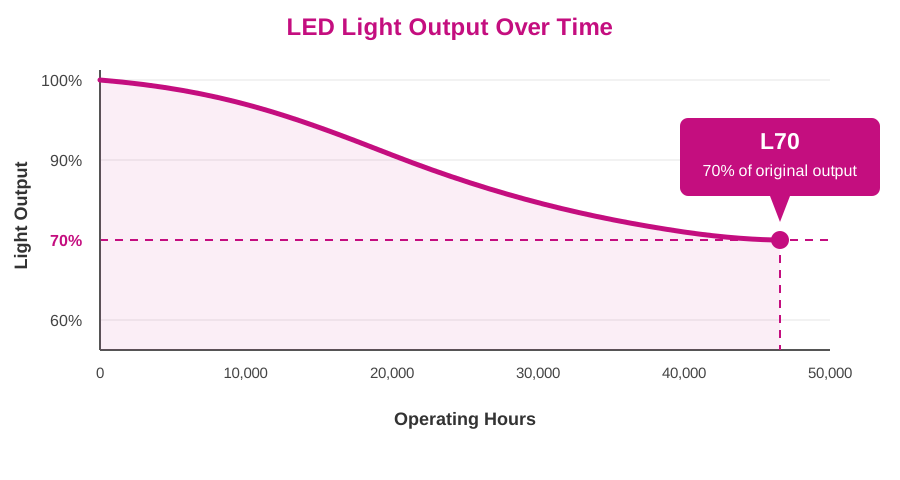 Illustrative example showing the point at which an LED has depreciated to 70% of its original light output. Actual performance varies by product and operating conditions.
Now for the more scientific answer to the question how long do LED strip lights last?
To explain, LEDs will not normally ever burn out, but instead they will gradually decreases in light output until they are too dim to use anymore. How dim is too dim? This is widely based on the L70 metric, which states that 30% of light depreciation or 70% of light remains should be the end and it’s time to think about a replacement. It stands for the number of hours an LED bulb would take to diminish to only 70% of its original light output.
Calculating the L70 metric
The issue here is that several factors can influence how long it takes an LED light to diminish to 70%. This includes material quality, component durability, and how the LED is used. In general, higher temperatures and higher drive currents cause LEDs to degrade more quickly. This leads to a faster decline in light output.
To ensure consistency across the industry, a standard testing method called LM-80 was introduced. This involves testing LED samples at controlled temperatures and electrical currents, with light output measured every 1,000 hours up to a maximum of 10,000 hours.
Reputable manufacturers and suppliers should be able to provide LM-80 reports, especially for bulk or commercial orders. However, these full lifespan tests can take time as running LEDs continuously for 10,000 hours takes over a year. Testing for a full 50,000 hour lifespan would take nearly six years, which isn’t practical in a fast paced industry.
To address this, the TM-21 extrapolation method was created. TM-21 takes a sample of LM-80 test data across just the first several thousand hours and uses it to estimate how long the LED will last before reaching its L70 point. This projected figure is what you’ll usually find in product datasheets and warranty information.

LM-80 Testing
LEDs are tested at controlled temperatures and electrical currents, with light output measured over several thousand hours.
TM-21 Extrapolation
LM-80 test data
Actual measurement
TM-21 projection
Extrapolated estimate
TM-21 uses LM-80 test data to estimate how long the LED will last before reaching its L70 point.
Reasons why LED lifetime claims may be incorrect
While LM-80 and TM-21 are industry standard methods for estimating LED lifespan, their accuracy depends heavily on how the tests are carried out. It also heavily relies on and how the data is interpreted. Below are three key reasons why some LED lifetime claims might be misleading.
Limited test duration affects the maximum claim
The TM-21 method only allows manufacturers to claim a lifespan of up to six times the duration of the actual LM-80 test. So, if an LED is tested for 5,000 hours, the maximum claimable lifespan would be 30,000 hours. This is true even if the performance is flawless. This is important though as it prevents overinflated claims based on short term data.
Test conditions must exceed real world use
LM-80 requires LEDs to be tested under harsher conditions than they'll typically face in real use. They tend to use higher temperatures and stronger drive currents. These variables are critical because heat and power load are the two main factors that shorten LED life.
Not all real world factors are accounted for
LM-80 and TM-21 tests don't cover every environmental factor. Humidity, airborne chemicals (like VOCs), and materials used in waterproofing can all impact LED performance. But they aren't factored into the standard testing. There's also little regulation around materials used in production. So the test samples might use high quality components, while lower grade production versions perform differently.
LED strip colour shift
In addition to gradually losing brightness, some LED strips can also shift in colour as they age. This change isn’t usually listed in standard technical specifications, but it can be observed in the LM-80 test report. This is a useful document if colour consistency is important for your particular project.
To measure this, the lighting industry uses a metric called “delta u’v’”, which tracks colour stability over time. A shift greater than 0.003 on this scale is typically noticeable to the human eye. If you’re sensitive to colour changes, or working in an environment where colour accuracy matters, this is a number worth checking.
For most indoor applications, a metric of less than 0.006 over the LED strip's lifetime is considered acceptable. However, for more demanding installations it's best to choose LED products specifically designed for enhanced colour stability. For example, in museums or art galleries.
Colour consistency matters
A delta u’v’ shift above 0.003 may become noticeable to the human eye, particularly in applications where accurate and consistent colour is important.
Do LED strip lights get hot or burn out?
Yes, LED strip lights do generate some heat, but far less than traditional bulbs. The latter wastes up to 90% of their energy as heat, which can make them extremely hot to the touch. On the other hand, LEDs are much more efficient, with only 20% of energy lost in heat. They are able to manage heat with built-in heat sinks that safely disperse warmth into the surrounding air. This keeps the strips cooler and more efficient.
One thing LED bulbs won’t suddenly do is burn out, unlike traditional incandescent bulbs. Instead, they typically begin to gradually lose brightness over time, as mentioned above with the L70 metric. This is a process known as luminous decay and this assures you’ll never be left in the dark without warning.
For more information please visit our other blog – Do LED Lights Get Hot? (And Are They Safe?).
It’s not just about the LEDs
When we talk about the lifespan of LED strip lights, it’s easy to focus solely on the LED bulbs themselves. But in reality, it’s not always an issue with the bulb if there is a fault or sudden loss of illumination. The adhesive backing and the power supply unit (PSU) also have a role to play and are actually more likely to fail first if not properly maintained.
The self-adhesive layer that attaches the strip to a surface can degrade over time. This is especially true in environments exposed to dust, moisture, heat, or direct sunlight. As the adhesive weakens the strip may start to peel away or fall off completely, regardless of whether the LEDs are still working. To avoid this, install LED strips on clean, dry surfaces and consider additional support (like mounting clips) for long term applications.
Power Supply Units (PSUs)
LED strip lights are only as reliable as the
power supplies behind them. The PSU is a key electronic component and if it fails, it is likely to do so suddenly. This can leading to flickering lights or a complete blackout. Reputable power supply manufacturers provide a Mean Time Before Failure (MTBF) rating, which gives an idea of the expected lifespan. However, real world performance depends on how it’s used and the conditions it operates in, as with LED lights!
To maximise the life of your power supply you should:
- keep it cool, dry and dust-free
- avoid overloading it
- ensure the power use of your LED strip stays within the limits of your PSU
By paying attention to these supporting components, not just the LEDs themselves, you’ll get better performance and longer life from your LED strip lighting setup.
Find out more information on LED strip lights with Vision Lighting
Hopefully, we have answered the question – how long do LED strip lights last? If you need any more information though we will be more than happy to help. Here at Vision Lighting we are a leading supplier of high quality LED strip lights, so we know a thing or two! We also offer a 14-day returns policy, next day and weekend delivery, as well as expert support on the phone or by email.
If you would like more details on any of our products, or advice on the lifetime of your new LED strip lights, please do not hesitate to give us a call on +44 (0) 1132 799745. You can also send an email to info@vision-lighting.co.uk. We will get back to you as soon as we can.
Ultimately, LED lifespan figures should be treated as a useful comparison rather than an absolute guarantee. While LM-80 and TM-21 provide recognised industry methods for estimating performance, the real lifespan of an LED product will always depend on component quality, thermal management, installation conditions and operating environment.
When comparing LED lighting products, don't just focus on the quoted lifespan. Consider the manufacturer's reputation, warranty, test data and overall build quality to ensure you're investing in a product that will continue to perform reliably for years to come.